Structure Is the Interface
Why AI output is shaped long before the prompt is written

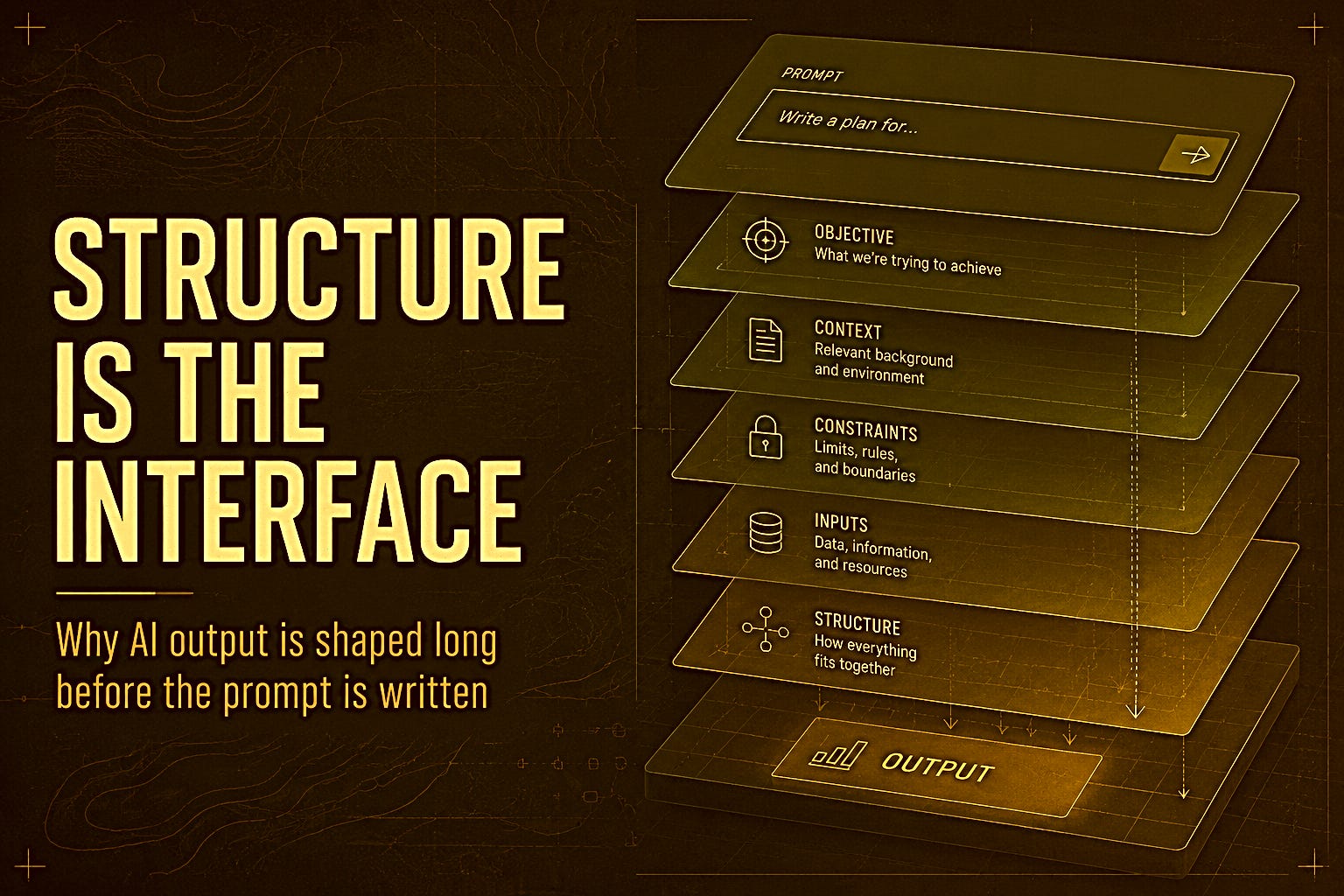
Most people think the prompt is the interface. It’s not. The prompt is just the visible surface—the last step in a much larger system. What actually determines the output is everything that exists before the prompt is written.
AI doesn’t respond to intelligence. It responds to structure. That’s easy to miss, because when the output looks good, it feels like something intelligent happened. But what you’re really seeing is alignment: a clear objective, defined constraints, relevant context, and coherent inputs. When those are in place, the response improves. When they’re not, it degrades quickly.
Most people approach AI like a conversation. They type something in, see what comes back, and adjust from there. That works sometimes, but it’s inconsistent because the underlying structure is inconsistent. The system has nothing stable to respond to, so the quality of the output fluctuates with the quality of the input environment.
In real-world execution, we don’t operate that way. Or at least, we shouldn’t. We don’t build teams, run programs, or execute complex work based on loosely defined intent and reactive iteration. We define what we’re trying to achieve, what constraints exist, what inputs matter, and what success looks like. Without that, output varies—not because people aren’t capable, but because the system itself isn’t structured.
AI behaves the same way. Give it a well-structured environment and it performs. Give it ambiguity and it fills the gaps with probability. That’s where most of the frustration comes from. Not because the tool failed, but because the structure did.
In practice, structure isn’t abstract. It shows up the same way it does in any operational environment. In the military, execution begins with clarity around mission objective, commander’s intent, constraints, available resources, and defined responsibilities. Without that, execution breaks down quickly—no matter how capable the team is.
In corporate environments, the pattern is the same. When work is well-structured, teams understand what problem they’re solving, what success looks like, what constraints exist, and who owns what. When that structure is missing, output becomes inconsistent. Not because people aren’t working hard, but because the system isn’t aligned.
AI operates inside that same reality. A well-structured environment isn’t about better wording. It’s about clarity of objective, context, constraints, and inputs. When those are defined, the system performs. When they’re not, it fills the gaps.
This is where the idea of the “prompt” becomes misleading. It suggests that the quality of the interaction is driven by wording. But wording is downstream. Structure is upstream. And upstream determines everything that follows.
You can see this play out quickly. Take the same AI system and ask it to solve a problem once with vague intent and once with clear constraints and defined context. The difference in output isn’t subtle.
It’s structural.
That distinction matters because it shifts where you focus your effort. Instead of asking, “What should I type?” you start asking, “What structure does this problem actually require?” In most organizations, that’s where things break down. Work starts before structure is clear. Execution begins before constraints are defined. Teams move before alignment exists. Then people wonder why the output is inconsistent.
AI doesn’t hide that problem.
It accelerates it.
There’s no meeting to reinterpret intent. No manager smoothing over ambiguity. No delay between input and output. The system responds immediately—with exactly what it was given. That’s why it feels unpredictable to some people and incredibly powerful to others. They’re not necessarily using it differently at the surface. They’re bringing different levels of structure into the interaction.
If you treat the prompt as the interface, you’ll keep optimizing wording. If you understand that structure is the interface, you start designing the system behind the interaction. That’s where the leverage is—not in saying things better, but in defining things more clearly.
Because once the structure is sound, the output becomes predictable. And when output becomes predictable, it becomes usable.
Most people are trying to get better results by improving their prompts. A smaller group is starting to realize:
The prompt isn’t the interface.
It’s the reflection of it.